Wednesday, March 25, 2015

ED 722 Week 12

 What do you think about iNACOL’s New Learning Models Vision? Are there limitations or disadvantages to such an approach? Is it feasible? Do you find that there are advantages for you as you create your own environments?

The Matrix of Data

When I read advertisements about perfect learning environments like the ones portrayed in the iNACOL article, I feel the cynicism rising up into my brain, like acid poured on a beautiful painting. I step back and force myself to remember that great ideas start with dreams. iNACOL is doing important work.
Image by geralt on Pixabay


Positives: personalization, opportunity to learn at child's own pace, instant feedback, flexible teaching and learning, 24/7 learning opportunities, supports for educators
Worries: flexible staffing, 24/7 tutoring, funding follows the student, year-round learning, progression based on mastery

It will take a lot of work to steer our education system away from the industrial model and toward relevant, personalized learning. As a high school teacher, I observe students who are unable to function without explicit one-on-one instructions and feedback from a teacher about the minutest detail of every aspect of an assignment. Teachers are frustrated by the unmotivated students that our public school systems has created.  Common core and blended learning can be wonderful tools to unlock students' potential, but teachers need to buy into it. I am looking forward to a time when incoming students who have experienced aligned curriculums come through the doors.


Some of the benifits are also worries. It is convenient for students to have their teachers on call 24/7, but is it reasonable for staff? Will flexible staffing mean less teachers with more qualifications? With a focus on mastery, what happens when students do not progress with their peers? Are we expecting utopia?

If this is to come about, there will be serious growning pains. I believe the results will be worth the effort. I see myself as a resource to staff to try new ways of teaching using technology. If I had not enrolled in the IT&DML program, I would be paralyzed right now.

The New Media Consortium Horizon Project Preview was written in 2013. We are in 2015, and the Consortium was on target. Schools have embraced cloud computing and mobil learning is spreading rapidly. Although this has been brewing steadily, the advent of Google Classroom has really made things "pop." 


Big data in education (LOVE that explanation!), officially known as learning analytics, has also taken root. We have had "data teams" in place for a couple of years and teachers, at least in my school, attach data to their SLOs. Using learning platforms like Google Classroom and Schoology encourage open content, though I think most teachers are unaware of Creative Commons licensing.

The final two big shifts, 3D printing and Virtual and Remote Laboratories, are still cutting edge. Personally, I am not sure we need 3D printers. We have one in our school. I will make a point to introduce myself this spring. Virtual labs have been popular for frog dissection and other small things for quite some time. It will be interesting to see how remote labs come to fruition. I expect that in higher education.

There are huge changes taking place due to the vast, unmanageable amounts of data making its way onto the internet daily. I believe it is important that educators learn how to manage the data themselves, a nd teach their students how to filter and use the information responsibly. One side affect of this flood of information is the mistrust of experts. Not everyone, even someone who has discovered massive amounts of content on a subject, can be an expert in any field. I have a friend who is a doctor and researcher. He finds that his young-adult students, used to being considered experts, pay little attentiong to mentors in their field because they feel they know it all. To me, this reflects our general lack of respect for authority, be it age, experience or knowledge, that our society instills in their offspring.

Here is a link to this week's STORIFY.

References:
iNACOL's New Learning Model Vision, InternationalAssociation for K-12 Online Learning, 2013
NMC New Horizons Project 2013: K-12 Edition, New Media Consortium, 2013


Friday, March 13, 2015

BADGES!

I went to the CECA/CASL conference this fall and a presenter talked about putting PAPER  badges on  teachers' doors. I tried it with "Google Classroom" users and I had teachers coming out of the woodwork looking for recognition. It fizzled out as more people came on board. Teachers who weren't involved in Classroom wanted badges for other technology they were working with.  

 
My badge looked a lot like this!

On another "recognition" note, our principal has encouraged us to put "drops" in teachers' buckets who have made some kind of positive impact on us or students. I get drops every month for perfect attendance (I'm a bit competitive) and give them often for all kinds of things. Some people I "awarded" were annoyed - it was a "badge of honor" for them to have no drops.

Recognition can work... or it can backfire.

I liked the term, "disruptive" - sometihng that appears where there has been no market. Badges have been awarded in Scouting and other venues (like war) for specific skills for a very long time. The disruptive thing about badges is that they are being awarded for education skills, mostly for free, in an area that is traditionally expensive. Instead of degrees and certification, people can get recognition for skills through the metadata attached to their badges. It will be interesting to see if this catches on with employers. 

Right now, badges are novel, and people are willing to award badges for free (or as part of a paid course.) For badges to be meaningful, live people need to assess the skills for the awards. This works well in a school/classroom situation because assignments are graded as a matter of course. For job-based skills, the badge system can't stay "free" because those who award badges will not want to do it for long without some compensation.

I can see badges for:
- Teacher PD
- Teacher education
- Individual skills as part of a class
I don't really see it catching on outsife of school. Who knows? I may be wrong.

Here is the link to this week's  STORIFY.

Resources:
Fertig, R. and Pytash, K. There's a Badge for That. Tech and Learning. 2/26/14.
     http://www.techlearning.com/news/0002/theres-a-badge-for-that/63725
Randall, D. et al. Designing Open Badges for a Technology Integration Course. Tech Trends.      
     November/December 2013. Vol.57, No. 6.


Friday, March 6, 2015

Why do we educate our children?

"Ultimately, the current educational system was designed to meet different needs and goals than we currently face in the information age." William Watson

Sir Ken Robinson, Wikipedia photo


I started the readings on Monday night by viewing the video of Sir Ken R0bertson. He was entertaining and believable while I was in his spell. I was so excited about the information. When I went in to school on Tuesday, reality set in. I interacted with teachers who are trying to cram 180 days' of instruction into 90 days, are missing too much instructional time because of snow events, and have upcoming district-wide and high-stakes tests to prepare students for... which also detract from class time. 

How do we slow down and let students be creative? 

I came upon a discussion with one the security guards and a coach in the lobby about the high cost of college education, which caused me to recall the Sir Ken's  comments about how a college education used to mean a guaranteed job, but you now need a Masters' or Doctorate to for that guarantee. (I was intrigued, so I watched one of his TED talks.) I left school thinking, "Why do we educate our children?"

On Tuesday, I chose to read the selection about Interactive Learning Environments. The quote at the top of this page jumped out at me. "Ultimately, the current educational system was designed to meet different needs and goals than we currently face in the information age." Until we set a purpose for education, we are spinning our wheels. Is our purpose job-training? Are we looking for an across-the-board base-knowledge for students to build on? Are we preparing students to build a resume for college acceptance? Are we preparing students to thrive in the 21st Century? Seriously, why do we "do" school?

CMS's - Course Managements Systems
PLE's - Personal Learning Environments
PIES - Personalized, Inegrated Education Systems

Students must "buy into" education. At my school, we have "all the bells and whistles": a high school diploma, trade education, college scholarship possibilities, work-based learning... and many students are not motivated. They see no value in education... until after graduation. Many students come back and lament about how they wished they had taken school seriously.

There are so many easy-seeming options available to today's youth. There is no need to interact with others. The computer is right there. Spell? The computer can do that. Calculate? There's an app for that.

Our job, as teachers is to make learning personal, valid, meaningful, practical, REAL. There is no need to calculate a correct answer unless the answer is personal. There is  no need to spell something correctly unless the reason is personal. We have amazing tools at our disposal. (Databases vs. Readers' Guide to Periodical Literature - or Easybib vs. hand-crafting a bibliography) Whether we structure activities on paper or in the cloud, using a 3 ring binder or in our Google Classroom, we need to make the material relevant. 

Here is a link to my STORIFY for the week.

William R. Watson , Sunnie Lee Watson & Charles M. Reigeluth (2013): Education 3.0:      
        breaking the mold with technology, Interactive Learning Environments,DOI:10.1080/
        10494820.2013.764322
Robinson, Sir Ken. Educating the Heart and Mind.
Robinson, Sir Ken. Do Schools Kill Creativity? https://www.youtube.com/watch?v=iG9CE55wbtY

As an aside: We have so much in the USA.  Education is "free" for everyone. Our politicians fight about it. We struggle to engage the kids. We sink more and more money and time into gadgets and software and teacher training.
In poor countries, where education is either expensive or rare, it is valued - even in an overcrowded one-room schoolhouse with no supplies or desks. Why?

Friday, February 27, 2015

Blended Learning Curriculum Design


BLC = blended learning curriculum
VLE = virtual learning environment


Teacher activities


Pre-analysis -
prepare the students for the lesson
Preassessment
Demonstrate what you're looking for


Instructional design -
Activities
Resources


Assessment -
Process
Product


Student Activities
Lead in, Define the task, explore resources
Plan, describe the problem, brainstorm
Act, research, write
Review, present, critique, reflect

I think, overall, this makes sense. It seems to work for expanding college education opportunities and having larger class sizes at Chinese Universities. Would it work in the US? US students seem to excel in smaller, more personal classes. Just a thought...

Storify about BLC

Friday, February 20, 2015

ED 722 week 7 Rogue Reflection

Please discuss the most potent points in the discussion this week.
What instructional and pedagogical opportunities are out there to build student voice, choice, and agency? How will you create learning experiences for your unique learners?

Arrrgghhhh!

Teach like a pirate! We watched two Google Hangouts this week. I pulled out my knitting and took some notes. 
- Create an experience
- You will have some failures...keep going
- Look to alternative assessments for memorable understanding
- Build up to a great lesson...market it. 
- Passion for teaching is critical!
- Triple Venn Diagram
- Teachers are willing to take risks and sail into uncharted waters.

THIS WEEK's REFLECTION is a Powtoon presentation. I need to practice for an upcoming PD.

My Storify for this week

Dave Burgess focused on the performance aspects of teaching. His premise is that students need a "hook" to draw them in and make them want to learn. Creating an experience, rather than simply teaching a lesson, is an important way to differentiate instruction.

The experience could be the way a room is set up to engage the students. One of the SSCHAT teachers talked about eating gluttonously during a lesson. Dave talked about a "life-changing" sight and sound experience revolving around the moon walk. When more senses are engaged, students will learn more deeply.

The experience is not only what the students passively absorb, it can be the projects they create alone or together. The gamifiers talk about minecraft. Another SSCHATter had students recreate the map of the middle east in mud behind the school. Many teachers talked about projects that involve collaboration.

This week in health class, the teacher asked me to show the students "something different from Power Point." Together, we looked at Haiku Deck and Prezi, but my dramatic build-up was to Powtoon. It takes longer to learn, but it is really fun to make an engaging, humorous presentation. The students were really absorbed in creating scenarios for their on-screen characters, cementing the information about steroids in their brains. Although students were responsible for individual projects, they collaborated while discovering different aspects of the program.

Would anyone pay admission to see one of my lessons? No. But it gives me something to aspire to. I'll need to practice.

Monday, February 9, 2015

ED 7722 Week 6 -

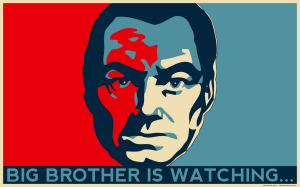
Should we actually be worried about big brother and privacy as we try to engage 21st century learners in a connected environment? Is the cloud the right way to go as we begin to embrace ubiquitous learning? Are there ethical and legal implications of this new embrace to connectivity? Please reflect on what resonated with you this week and why.

Image: Nighted.deviantart.com

The three required videos were on disparate topics, so I cruised the additional readings, focusing on privacy.

I didn't follow the Edward Snowden situation when it first came out. I was aware of it. I listen to NPR. But my shallow and comfortable mental conversations sounded like, "Unless you are doing something suspicious, you have nothing to worry about. Let's see who posted for class today..." (I tend to focus on things that obviously affect me and that I can actually do something about.)

Like most aspects of technology, the laws and regulations cannot keep up with the constant innovation. The Security Now podcast made a good point. We want everything to be simple, but simplicity leads to unsecured information. NOTE: Update your computer as soon as you are notified of patches. The window between the new release and the time you update is when your computer is most vulnerable to hackers.

We want everything at the lowest cost. Some of the privacy issues revolve around targeted advertising (Solove.) In my opinion, ads are the price we pay when we have "free" access to the Internet items we consume. As we introduce technology into our schools, we are most likely to use free apps for cost savings. I know our system has received grants for hardware, but not for software or salaries for the extra technicians to keep the hardware working.

I don't see any obvious "Big Brother" issues with cloud and 21st Century learning. Closed programs like Google Classroom and Edmodo give an aura of security about student information. As long as students are following their teachers' guidelines and not seriously planning world-domination, there is no good reason for "Big Brother" to keep track of student work. The one area that could be an "issue" is parents who do not want their child to have a presence on the Internet.

It is disturbing that that US Government has created large storage facilities for huge amounts of metadata from billions of people (Gibson.) It sounds expensive. It is also disturbing that the entity that is supposed to be monitoring the activity, Congress, is being lied to... if the information about the situation is reliable. Maybe it would be OK to inform the public about the fact that the data is being collected and how, but that would cause those who don't want to be watched to figure out a way around "the system." What is right in one situation would be disastrous in another situation. It reads like a complicated espionage novel with no good solution.

Resources:
Solove, D. The Year in Privacy 2013 and the Year to Come. LinkedIn. 12/30/13.
Gibson, S. Security Now. Episode 408: Security State. TWiT. 6/12/13.

As for the required videos:
Connected Learning: All of the narrator's examples focused on things done at home, one-on-one, that cause deeper engagement. The idea of implementing her solutions sounds amazing, and would be time consuming to translate into individualized experiences for students. As the narrator implied, as long as we continue to focus on test scores, we will not spark the curiosity to create the context for learning that gets students viscerally engaged.
Internships: The students who go on "Work Study" at my Technical High School learn so much about their trade. It would be ideal to offer these kinds of experiences to every student in every school, but is it practical or possible?
RSA Animation: Fascinating take on working environments. I wish we could do distance learning for snow days! I know some schools are working on it.

Link to my Storify this week.

Friday, February 6, 2015

ED 7722 Week 5 reflections

From the readings this week, explain what you find to be the most potent concepts that can be transferred into your own teaching practices and why. Remember to respond to at least two of your peers.

I took serious notes during the two videos about UbD (Understanding by Design) with Grant Wiggins. My teaching is all in collaboration with subject area teachers. I want to be able to more deeply engage students, as the topics I cover are necessary life skills for our time - Internet research, proper attribution, and such.

When Wiggins asked his pupils to write down a one sentence mission statement for their program, I didn't hesitate.
"Each student will become an independent researcher."
As far as an assessment (not a test), I came up with some thoughts, but for instruction, I drew a blank. I know where I need work.
Wiggins compared instruction to the video game, "Rock Band." How can we incentivize every lesson in every unit to keep students as engaged as they are in a video game?
I am not a video game developer.
I have more patience and self-motivation than the average student I encounter, and I'm not even sure what would keep ME that engaged? I stop playing my favorite games if an ad gets too long and I go back later.
Was education ever so exciting and engaging as today's video games? Is that attainable? I think pieces might be that exciting, but even a game like Rock Band can become dull over time.

When I initially read A Pedagogy is Emerging, I thought, "Oh no...same old same old..." and dismissed the article. After skimming some of my cohort's reflections, I thought I might have missed something, so I re-read the article, focusing on the point that it referred to post-secondary education.

There are three shifts in pedagogical trends in higher education right now. We are enjoying these trends in our sixth year program: flexibility, change in power between professors and students, and growth assessments. Because we in ITDML are all motivated learners who want to use the material, it works. As an adult learner, I appreciate the flexibility, rapport, and feedback and feel like I am truly learning the material. That said, I work with high school students. Until we hold them, rather than the teachers, accountable for their own learning, the pedagogical shift cannot happen.

References:
Bates, T. A Pedagogy is Emerging...and Online Learning is a Contributing Factor. Contact North, 2015.
Wiggins, G. Understanding by Design videos.