Showing posts with label #ITDML; #DistanceLearning. Show all posts

Sunday, March 29, 2015

Reflection as a learner

I am the Library Media Specialist at my school. In the past, much of my teaching involved demonstrating tools such as the EasyBib bibliography generator or iConn.org for research. Lately, because we are in the process of adopting Google Classroom in our system, I collaborate with teachers to integrate technology into their lessons.  The staff defers to me as the resident “expert,” partly because I am the administrator on the school’s account, and partly because I take the time to find out the answers to their questions.

In and out of the classroom, I tend to be creative. My next few projects are already lined up. I enjoy playing around with new technology. When I make the time, is engaging. I get lost in the process, and work until I am satisfied with the results. In addition to having high expectations for myself (some call it being a perfectionist), I am reflective and look for ways to make improvements in all areas of my life. When working in a digital environment, it is important to “change things up” and find ways to keep assignments fresh and interesting. Students learn best when they are fully engaged.  Not every lesson will work the way it was intended, and it is important to reflect on what worked and what didn’t, and keep improving within the medium.

I am a compulsive email checker, and that is important when working in a digital environment. Because most distance learning is asynchronous, questions come in at different times. To prevent too many questions, it is important to give an overview, then present lessons in manageable chunks.  I am naturally curious and a quick learner.  Now that I am familiar with basic components of online learning, I feel comfortable expanding my choices of apps and media.

          At the beginning of the Distance Learning course, I was faced with the rumor that I would be teaching classes next year, rather than having an “open schedule.” Since ORMS (Online Research and Media Skills) is my curriculum, I started dreaming about some MOOC-style units on internet safety and research skills. The rumor was false, but the work in this course has inspired me to create some independent units that are flexible enough to work into different subjects in our building.

Josh and I worked on an Internet Safety unit for our learning module. I found many of the resources for our project early on, and we collaborated (asynchronously) on the learning objectives, lesson plan, and overall format. Once the research was done, it all came together quickly. Doing research and teaching research are two major elements of my teaching practice.

          During the Distance Learning course, I started a Technology Coaching MOOC. The best coaches do not come across as experts.  They encourage others to learn alongside them. Coaches provide encouragement and support, and allow the learner to make discoveries. Good distance learning should do the same. The instructor needs to entice the learner with an exciting premise, provide the scaffolding for learners of different dispositions and learning styles, and allow the learners to be challenged and to grow.

In order to be a truly effective online educator, I would need access to a class for more than one period. Our students experience only 90 days of “academics” per school year, which makes it a struggle for me to teach with depth any of the research and documentation skills I feel student need. A Google Classroom collaborative teaching project with library skills embedded into a project may work effectively as a blended learning unit.

          The biggest “support” I would need is a reliable web platform for my tutorials. Currently, we are “between platforms” and the current website does not support enough data for video. I would like to embed general “how-to” videos on the library homepage. Temporarily, I have some tutorials on a Google Site through Google Classroom which is linked to the Abbott Tech website. I have also created some quizzes and tutorials that were embedded in teachers’ Google Classroom lessons.  

          Another challenge is collaboration time. Because I watch students who come to the library all day, and there is no common planning time for departments in my school, there is very little uninterrupted time for collaboration. Google Classroom, the platform we use at our school, is not collaboration-friendly at this time. Either I or the other teacher would be responsible for the “Class.” We would need to share documents and responses.

          When I began my IT&DML coursework two summers ago, I was uncomfortable with instructional technology. I was also reticent about taking online courses because I had heard horror stories about them from friends who had taken them. Much of our coursework has been distance learning, and it has not been like those others’ experiences.  In the ED 722 Distance Learning course, learning about the way successful distance learning courses are intentionally prepared has been meaningful.


          Are MOOCS really the wave of the future or just a fad? Is there really a new pedagogy, or are we just remixing? Is our online data safe? Can we all learn the skill to teach like a pirate? Only time will tell.

Friday, March 13, 2015

BADGES!

I went to the CECA/CASL conference this fall and a presenter talked about putting PAPER  badges on  teachers' doors. I tried it with "Google Classroom" users and I had teachers coming out of the woodwork looking for recognition. It fizzled out as more people came on board. Teachers who weren't involved in Classroom wanted badges for other technology they were working with.  

 
My badge looked a lot like this!

On another "recognition" note, our principal has encouraged us to put "drops" in teachers' buckets who have made some kind of positive impact on us or students. I get drops every month for perfect attendance (I'm a bit competitive) and give them often for all kinds of things. Some people I "awarded" were annoyed - it was a "badge of honor" for them to have no drops.

Recognition can work... or it can backfire.

I liked the term, "disruptive" - sometihng that appears where there has been no market. Badges have been awarded in Scouting and other venues (like war) for specific skills for a very long time. The disruptive thing about badges is that they are being awarded for education skills, mostly for free, in an area that is traditionally expensive. Instead of degrees and certification, people can get recognition for skills through the metadata attached to their badges. It will be interesting to see if this catches on with employers. 

Right now, badges are novel, and people are willing to award badges for free (or as part of a paid course.) For badges to be meaningful, live people need to assess the skills for the awards. This works well in a school/classroom situation because assignments are graded as a matter of course. For job-based skills, the badge system can't stay "free" because those who award badges will not want to do it for long without some compensation.

I can see badges for:
- Teacher PD
- Teacher education
- Individual skills as part of a class
I don't really see it catching on outsife of school. Who knows? I may be wrong.

Here is the link to this week's  STORIFY.

Resources:
Fertig, R. and Pytash, K. There's a Badge for That. Tech and Learning. 2/26/14.
     http://www.techlearning.com/news/0002/theres-a-badge-for-that/63725
Randall, D. et al. Designing Open Badges for a Technology Integration Course. Tech Trends.      
     November/December 2013. Vol.57, No. 6.


Friday, March 6, 2015

Why do we educate our children?

"Ultimately, the current educational system was designed to meet different needs and goals than we currently face in the information age." William Watson

Sir Ken Robinson, Wikipedia photo


I started the readings on Monday night by viewing the video of Sir Ken R0bertson. He was entertaining and believable while I was in his spell. I was so excited about the information. When I went in to school on Tuesday, reality set in. I interacted with teachers who are trying to cram 180 days' of instruction into 90 days, are missing too much instructional time because of snow events, and have upcoming district-wide and high-stakes tests to prepare students for... which also detract from class time. 

How do we slow down and let students be creative? 

I came upon a discussion with one the security guards and a coach in the lobby about the high cost of college education, which caused me to recall the Sir Ken's  comments about how a college education used to mean a guaranteed job, but you now need a Masters' or Doctorate to for that guarantee. (I was intrigued, so I watched one of his TED talks.) I left school thinking, "Why do we educate our children?"

On Tuesday, I chose to read the selection about Interactive Learning Environments. The quote at the top of this page jumped out at me. "Ultimately, the current educational system was designed to meet different needs and goals than we currently face in the information age." Until we set a purpose for education, we are spinning our wheels. Is our purpose job-training? Are we looking for an across-the-board base-knowledge for students to build on? Are we preparing students to build a resume for college acceptance? Are we preparing students to thrive in the 21st Century? Seriously, why do we "do" school?

CMS's - Course Managements Systems
PLE's - Personal Learning Environments
PIES - Personalized, Inegrated Education Systems

Students must "buy into" education. At my school, we have "all the bells and whistles": a high school diploma, trade education, college scholarship possibilities, work-based learning... and many students are not motivated. They see no value in education... until after graduation. Many students come back and lament about how they wished they had taken school seriously.

There are so many easy-seeming options available to today's youth. There is no need to interact with others. The computer is right there. Spell? The computer can do that. Calculate? There's an app for that.

Our job, as teachers is to make learning personal, valid, meaningful, practical, REAL. There is no need to calculate a correct answer unless the answer is personal. There is  no need to spell something correctly unless the reason is personal. We have amazing tools at our disposal. (Databases vs. Readers' Guide to Periodical Literature - or Easybib vs. hand-crafting a bibliography) Whether we structure activities on paper or in the cloud, using a 3 ring binder or in our Google Classroom, we need to make the material relevant. 

Here is a link to my STORIFY for the week.

William R. Watson , Sunnie Lee Watson & Charles M. Reigeluth (2013): Education 3.0:      
        breaking the mold with technology, Interactive Learning Environments,DOI:10.1080/
        10494820.2013.764322
Robinson, Sir Ken. Educating the Heart and Mind.
Robinson, Sir Ken. Do Schools Kill Creativity? https://www.youtube.com/watch?v=iG9CE55wbtY

As an aside: We have so much in the USA.  Education is "free" for everyone. Our politicians fight about it. We struggle to engage the kids. We sink more and more money and time into gadgets and software and teacher training.
In poor countries, where education is either expensive or rare, it is valued - even in an overcrowded one-room schoolhouse with no supplies or desks. Why?

Friday, February 27, 2015

Blended Learning Curriculum Design


BLC = blended learning curriculum
VLE = virtual learning environment


Teacher activities


Pre-analysis -
prepare the students for the lesson
Preassessment
Demonstrate what you're looking for


Instructional design -
Activities
Resources


Assessment -
Process
Product


Student Activities
Lead in, Define the task, explore resources
Plan, describe the problem, brainstorm
Act, research, write
Review, present, critique, reflect

I think, overall, this makes sense. It seems to work for expanding college education opportunities and having larger class sizes at Chinese Universities. Would it work in the US? US students seem to excel in smaller, more personal classes. Just a thought...

Storify about BLC

Friday, February 20, 2015

ED 722 week 7 Rogue Reflection

Please discuss the most potent points in the discussion this week.
What instructional and pedagogical opportunities are out there to build student voice, choice, and agency? How will you create learning experiences for your unique learners?

Arrrgghhhh!

Teach like a pirate! We watched two Google Hangouts this week. I pulled out my knitting and took some notes. 
- Create an experience
- You will have some failures...keep going
- Look to alternative assessments for memorable understanding
- Build up to a great lesson...market it. 
- Passion for teaching is critical!
- Triple Venn Diagram
- Teachers are willing to take risks and sail into uncharted waters.

THIS WEEK's REFLECTION is a Powtoon presentation. I need to practice for an upcoming PD.

My Storify for this week

Dave Burgess focused on the performance aspects of teaching. His premise is that students need a "hook" to draw them in and make them want to learn. Creating an experience, rather than simply teaching a lesson, is an important way to differentiate instruction.

The experience could be the way a room is set up to engage the students. One of the SSCHAT teachers talked about eating gluttonously during a lesson. Dave talked about a "life-changing" sight and sound experience revolving around the moon walk. When more senses are engaged, students will learn more deeply.

The experience is not only what the students passively absorb, it can be the projects they create alone or together. The gamifiers talk about minecraft. Another SSCHATter had students recreate the map of the middle east in mud behind the school. Many teachers talked about projects that involve collaboration.

This week in health class, the teacher asked me to show the students "something different from Power Point." Together, we looked at Haiku Deck and Prezi, but my dramatic build-up was to Powtoon. It takes longer to learn, but it is really fun to make an engaging, humorous presentation. The students were really absorbed in creating scenarios for their on-screen characters, cementing the information about steroids in their brains. Although students were responsible for individual projects, they collaborated while discovering different aspects of the program.

Would anyone pay admission to see one of my lessons? No. But it gives me something to aspire to. I'll need to practice.

Monday, February 9, 2015

ED 7722 Week 6 -

Should we actually be worried about big brother and privacy as we try to engage 21st century learners in a connected environment? Is the cloud the right way to go as we begin to embrace ubiquitous learning? Are there ethical and legal implications of this new embrace to connectivity? Please reflect on what resonated with you this week and why.

Image: Nighted.deviantart.com

The three required videos were on disparate topics, so I cruised the additional readings, focusing on privacy.

I didn't follow the Edward Snowden situation when it first came out. I was aware of it. I listen to NPR. But my shallow and comfortable mental conversations sounded like, "Unless you are doing something suspicious, you have nothing to worry about. Let's see who posted for class today..." (I tend to focus on things that obviously affect me and that I can actually do something about.)

Like most aspects of technology, the laws and regulations cannot keep up with the constant innovation. The Security Now podcast made a good point. We want everything to be simple, but simplicity leads to unsecured information. NOTE: Update your computer as soon as you are notified of patches. The window between the new release and the time you update is when your computer is most vulnerable to hackers.

We want everything at the lowest cost. Some of the privacy issues revolve around targeted advertising (Solove.) In my opinion, ads are the price we pay when we have "free" access to the Internet items we consume. As we introduce technology into our schools, we are most likely to use free apps for cost savings. I know our system has received grants for hardware, but not for software or salaries for the extra technicians to keep the hardware working.

I don't see any obvious "Big Brother" issues with cloud and 21st Century learning. Closed programs like Google Classroom and Edmodo give an aura of security about student information. As long as students are following their teachers' guidelines and not seriously planning world-domination, there is no good reason for "Big Brother" to keep track of student work. The one area that could be an "issue" is parents who do not want their child to have a presence on the Internet.

It is disturbing that that US Government has created large storage facilities for huge amounts of metadata from billions of people (Gibson.) It sounds expensive. It is also disturbing that the entity that is supposed to be monitoring the activity, Congress, is being lied to... if the information about the situation is reliable. Maybe it would be OK to inform the public about the fact that the data is being collected and how, but that would cause those who don't want to be watched to figure out a way around "the system." What is right in one situation would be disastrous in another situation. It reads like a complicated espionage novel with no good solution.

Resources:
Solove, D. The Year in Privacy 2013 and the Year to Come. LinkedIn. 12/30/13.
Gibson, S. Security Now. Episode 408: Security State. TWiT. 6/12/13.

As for the required videos:
Connected Learning: All of the narrator's examples focused on things done at home, one-on-one, that cause deeper engagement. The idea of implementing her solutions sounds amazing, and would be time consuming to translate into individualized experiences for students. As the narrator implied, as long as we continue to focus on test scores, we will not spark the curiosity to create the context for learning that gets students viscerally engaged.
Internships: The students who go on "Work Study" at my Technical High School learn so much about their trade. It would be ideal to offer these kinds of experiences to every student in every school, but is it practical or possible?
RSA Animation: Fascinating take on working environments. I wish we could do distance learning for snow days! I know some schools are working on it.

Link to my Storify this week.

Friday, February 6, 2015

ED 7722 Week 5 reflections

From the readings this week, explain what you find to be the most potent concepts that can be transferred into your own teaching practices and why. Remember to respond to at least two of your peers.

I took serious notes during the two videos about UbD (Understanding by Design) with Grant Wiggins. My teaching is all in collaboration with subject area teachers. I want to be able to more deeply engage students, as the topics I cover are necessary life skills for our time - Internet research, proper attribution, and such.

When Wiggins asked his pupils to write down a one sentence mission statement for their program, I didn't hesitate.
"Each student will become an independent researcher."
As far as an assessment (not a test), I came up with some thoughts, but for instruction, I drew a blank. I know where I need work.
Wiggins compared instruction to the video game, "Rock Band." How can we incentivize every lesson in every unit to keep students as engaged as they are in a video game?
I am not a video game developer.
I have more patience and self-motivation than the average student I encounter, and I'm not even sure what would keep ME that engaged? I stop playing my favorite games if an ad gets too long and I go back later.
Was education ever so exciting and engaging as today's video games? Is that attainable? I think pieces might be that exciting, but even a game like Rock Band can become dull over time.

When I initially read A Pedagogy is Emerging, I thought, "Oh no...same old same old..." and dismissed the article. After skimming some of my cohort's reflections, I thought I might have missed something, so I re-read the article, focusing on the point that it referred to post-secondary education.

There are three shifts in pedagogical trends in higher education right now. We are enjoying these trends in our sixth year program: flexibility, change in power between professors and students, and growth assessments. Because we in ITDML are all motivated learners who want to use the material, it works. As an adult learner, I appreciate the flexibility, rapport, and feedback and feel like I am truly learning the material. That said, I work with high school students. Until we hold them, rather than the teachers, accountable for their own learning, the pedagogical shift cannot happen.

References:
Bates, T. A Pedagogy is Emerging...and Online Learning is a Contributing Factor. Contact North, 2015.
Wiggins, G. Understanding by Design videos.


Tuesday, January 27, 2015

ED 7722 week 4 MOOCS

What is a "MOOC", and how does it intersect with the online, or hybrid learning environments that we've been studying? 
     

     I distinctly remember when I first heard about MOOCs. I was at the circulation desk reading a the Tech column in School Library Journal. I immediately Googled "Coursera" and perused their offerings.  I send an email out to my colleagues, and to my home email so I could further explore the possibilities. The concept was exciting! I didn't sign up for anything.
     This past summer, I heard Elizabeth Ferry speak about Technology Coaching in her Ignite Talk at an unconference. The concept intrigued me. At work, I found an email offering a MOOC about Technology Coaching, and I signed up. I met with some folks in my building who were interested, and they signed up. I enthusiastically made it through the first week of a six week course. I even participated in a big Twitter Chat and added folks to follow on Twitter. None of the others in my building even tried the first week. I fizzled out soon after, mostly due to procrastination.
     We did the ORMS MOOC as part of the IT&DML program. Because I knew the participants and I my grade depended on it, I did the work, completed the units, and got the badges. Keeping up was not problem.

The section in Ferdig's article about personal contact and having offline partners to improve MOOC completion really rang true for me. The Tech Coaching MOOC will be offered again in mid-February. Is anyone "game?"

     A MOOC, Massive Open Online Course, can be designed like a traditional class (xMOOC) or as a collaborative, connected learning experience (cMOOC.) As the poster above states, "every letter is negotiable!"
     The ORMS MOOC in the IT&DML was more like an xMOOC. Although there was class feedback and discussion on G+, the instructor guided the process. We submitted reflections and projects for badges and eventually for a grade. Other than the badges, the ORMS MOOC was similar to most of the online courses in this program. Read, reflect, respond, do projects.
     The Tech Coaching MOOC had hundreds of participants. It was overwhelming for me. It was more like a cMOOC. We reflected on readings, just like in our IT&DML classes, and could respond and read others' responses, but the sheer volume weakened the experience for me. I couldn't connect. I had a tough time seeing these strangers from all over the world as "experts" to learn from.

Here is the link to my this week's Storify.  https://storify.com/smarkiewicz11/to-mooc-or-not-to-mooc

Illustration: CC licensed by Matthieu Plourde.
Resources: Ferdig, R.E. (2013). What massive open online courses have to offer K-12 teachers and students. Michigan Virtual Learning Research Institute. Retrieved from http://media.mivu.org/institute/pdf/mooc_report.pdf

Friday, January 23, 2015

EDUC 7722 - Online Instructional Tool

This week, we were to
- choose an online instructional tool
- Learn how to use the tool
- Create a tutorial
- Storify about our tutorial creation
- Tweet out ... something... just TWEET!


I like being able to do tutorials. I get frustrated by Screencast-O-Matic's free version. I guess if it annoyed me enough, I would pay for it.
My goal is to keep a tutorial as brief as possible... 7 minutes max.
I also need to remember everything I wanted to talk about.
When I finally thought I had an acceptable video, there was no audio!

(loud long silent scream!)

Here is a storify of my experience:

https://storify.com/smarkiewicz11/formation

Wednesday, January 21, 2015

Free LMS Tools - a commentary

As we scale up and refine the LMS built using free tools (G+, Drive, Communities, Twitter, Google Groups, etc.), how well does this LMS support you and your learning style? How could it be improved? Feel free to be critical as you post as this contributes to the evolution of such systems...

IT&DML is my first experience with online learning. (Bloodborne Pathogen training doesn't really count!) Honestly, it makes me feel old. There are a lot of moving parts to keep track of, and they are not housed in the same place. - In a traditional class, I would have reading material and a notebook. I might type a paper and hand it in. Class discussion is in class, face to face.
- Online, there is reading or viewing material - which may be linked to the syllabus or in G+ or in a Google Document or an email - and I might have to respond on either my blog or directly on G+... or on another tool. I feel like I spend a lot of time trying to find things that I saw previously. It gives "Google Search" a whole new meaning! Now that I have an air printer, I have found it helpful to print some hard copies of assignments and check items off as I go. Discussion in G+ feels contrived. I want to respond without saying, "good point" over and over again. Asynchronous communication is handy, but it doesn't facilitate a lot of meaningful give-and-take conversation.

The iPad interface with Google is especially frustrating. I put all of my Google tools in a folder and I need to pop in and out of each of them to complete a project. The new Google Docs is particularly annoying on the iPad. If I go into Drive and open a Document, I can't return to Drive without closing Docs... and maybe some of this has to do with the fact that I haven't learned to properly navigate an iPad. Publishing with Blogger is awkward on Chromebook. When I publish, it goes public. When I share, it goes in the Community, where I want it. I often go back and erase my original published post.

I prefer to read on the iPad and answer on a computer or on my Chromebook.  I will confess, I didn't figure out Google Groups until this last summer. I started two summers ago. I still can only find it by following a link. Just today, I figured out why I had trouble participating in Hangouts last summer with a particular professor. Sometimes navigating the technology is more complicated than learning the class material!

I like many aspects of Communities. All of the discussions can be sorted by week, and it is easy to come up with a system for posting and for responding to posts. I enjoy trying new apps. I don't make much time on my own. It is helpful to see what my classmates are using.

The article we read this week, "An argument for clarity," was written before Google Classroom was rolled out. It is not a LMS as described by the authors. It is more like a CMS, like Moodle and Blackboard. 

I think using Google Classroom in IT&DML to corral all the apps would be an improvement. All of the parts would be in the same place, and it would be obvious where to post. This is likely why Classroom was created. Once in Classroom, a single click will put you in the right class vs. finding the right section in Drive, then drilling down multiple levels to find the day's work. (Stars in Drive DO help, but I need to remember I starred the item!) 

To sum it up, I like to find things quickly. There are too many places to look the way this LMS (or CMS, if we are using Watson's definitions) is set up.

Picture from Pixabay - free to share without giving credit.
Reference: Watson, W. and Watson, S. An Argument for Clarity: What are Learning Management Systems, What are They Not and What Should They Become. 2006.

Friday, January 16, 2015

EDUC 7722 - Week 2 - Learning Theory and Distance Learning

The argument is made that it is not just the incorporation of technology in pedagogy that facilitates learning, but it is instead the design of the environment and the interactions and types of connections that the technology affords. Do you agree with this statement? Why or why not? How will you design your environment considering these concepts and the theories discussed?


When technology was first introduced into classrooms, I think the first part of the statement, "the incorporation of technology in pedagogy," probably facilitated learning. Most people did not have computers at home in the 1980's. Video games, the most visible computer software, consisted of eye-hand coordination challenges. Students were enthralled by the magic they could perform programming with BASIC. Even rote practice exercises seemed less dull using a keyboard and screen rather than paper and pencil.

Today's technology is very different. The utilitarian data processing machine has transformed into a playground of information, games, and "productivity" for all age groups. Television is now dull compared to the magic of apps and the Internet. When students can connect instantly in exciting ways to friends and strangers with a palm-sized device in their pocket, why should they expect any less from their school interactions on a computer?

In today's technology context, I fully agree with the second part of the statement, "the design of the environment and the interactions and types of connections" facilitate learning today. Teachers have been creating lessons based on the cognitive learning style since before the class of 2015 entered Kindergarten. Today's students have an expectation that they will be building off of prior knowledge. Material will be chunked or they will have been given an outline, the presentation of the material will engage their senses, and, if they are going to challenge themselves to learn it, the information in the lesson should seem "relevant" beyond the next summative assessment.

My work environment is the school's library media center. I started to look into the Learning Commons movement a couple of years ago. This vision posits the library as the academic and social hub of the school. This allows for much student independence, but in my relatively small space that is frequently used for testing and classes, it will not work. It would be too chaotic for my vision of the library as a productive work space.

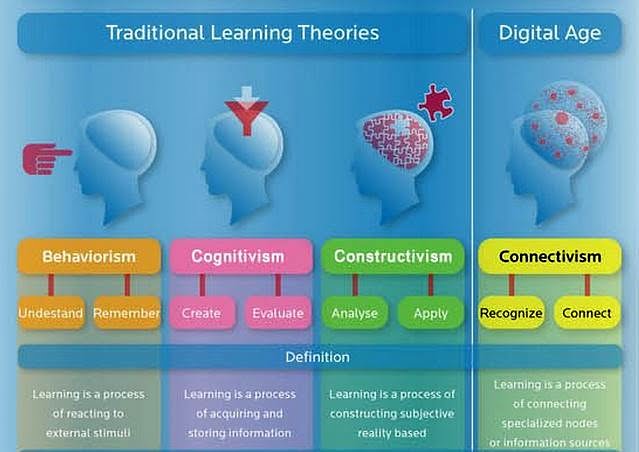
Right now, when monitoring students from study hall, I fall back on Behaviorist-style prompts to keep students on task when their school tasks alone don't engage them. I see my design goal to be rely on Constructivism. Research and other library skills lend themselves to building on current knowledge and using it in the real world.

Storify - Learning Theories

Image from Jonathan Vernon's My Mind Bursts Blog.
Reference: Ally, M. Foundations fo Educational Theory for Online Learning. Chapter 1.

Friday, January 9, 2015

ED 7722 - Distance Learning (week 1) #ITDML

Reflections on Distance Education in the United States: Past, Present, Future.

I love to learn.
That said, I don't enjoy eLearning... unless I want the answer to a specific question.
I started a correspondence course for writing children's books. Fail. I bought a CD course about Chaos Theory. Fail. I started a MOOC to learn more about technology coaching. Fail. I am slowly working my way through the Google Educator lessons. Did I mention SLOWLY? Unless there is a community with others I have met face-to-face, I have little motivation to gut through the courses.

Although Distance Learning sounds like a cure for the growing cost of education, drawing from my own experience, it is impractical. I work in a high school with 700 bundles of hormones. They are interested in each other. Period. If they weren't forced to sit in a classroom with their peers and an instructor working to keep them focused, they would learn very little. Honestly, unless they are personally interested in the subject matter, they don't seem to retain much anyway, except in their trade classes.* Every year, a handful of students who paid little attention to their schoolwork come back and say, "I wish I had taken school more seriously."

Maybe we created this kind of society with our "industrial" style, one-size fits all learning environment. People choose how to best navigate an environment, and our student of all learning preferences either master the process or totally shut down. 

The mention of homeschooling in the article piqued my interest. I was a public librarian in the early 1990's. Some of our "regulars" were homeschool families. Most of the children were well-read, polite, and had learned how to learn. Some started college courses at 16 because they were academically ready. This population, which has been brought up learning through an individualized plan, are better-suited for online learning than the traditionally schooled population.

Although Farhad Saba's article shows a rather pessimistic view of the evolution of distance learning, I am looking forward to looking at some strong examples and "best practices" in the field this coming semester.


*I work in a Technical High School. Students spend about 2 weeks in "academics" then 2 weeks in their trade. They get about 90 days in each.

Resource:

Saba, F. Distance Education in the United States: Past, Present, Future. Educational Technology. November-December 2011. pp. 11-18.

(I just watched a YouTube video to figure out how to embed my Storify in my blog post.  It was not specific, so if you want to do it (in Blogger), copy your embed code from Storify. Look in the upper left corner of Blogger. See Compose and HTML. Click on HTML. Insert the code where you want the Storify to show up. Go back to compose and check it out!)